PRRS Oral Fluid Testing & On-Farm Multiplex PCR Workflow for Pig Herds
Snaring dozens of nursery pigs or replacement gilts for individual blood draws every week slows down staff, stresses animals, and still misses subclinical shedders hiding between tested pens. Cotton chewing-rope PRRS oral fluid testing turns pig curiosity into pen-level composite sampling in 25 minutes.
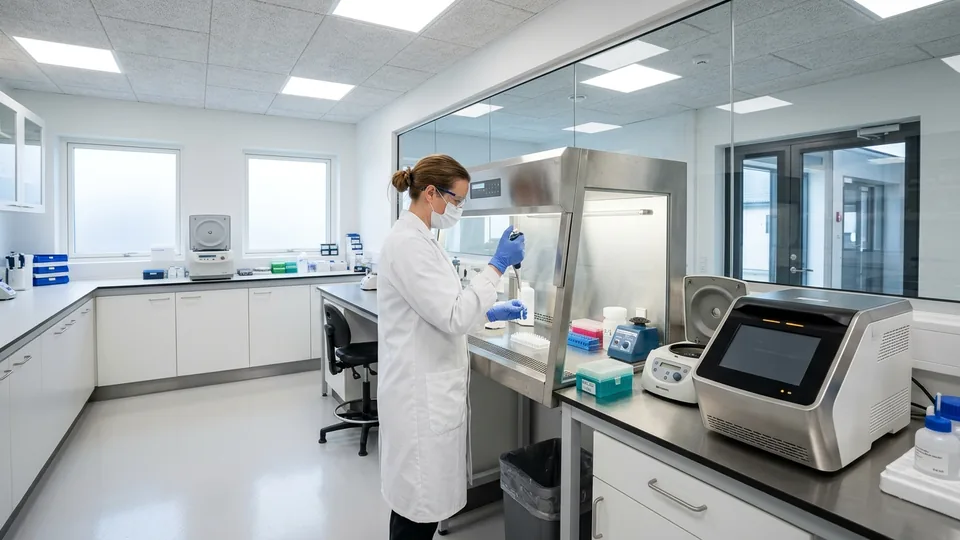
Paired with closed-cartridge rapid PCR analyzers inside a simple under-15 m² gate office, farms screen oral fluids, processing fluids, and truck swabs locally. One benchtop platform differentiates North American (NA), European (EU), and HP-PRRS strains alongside PEDV and Porcine Deltacoronavirus without waiting 72 hours for outside couriers.
1. Why Chewing-Rope Oral Fluids Catch Silent PRRS Shedding Better
When PRRSV circulates at low prevalence across gilt acclimatization barns or post-weaning nurseries (under 5% active shedders), bleeding only five random pigs per barn frequently generates false reassurance. In contrast, hanging a clean unbleached cotton rope at shoulder height invites almost every pig in the pen to chew simultaneously.
Over 20 to 30 minutes, saliva, serum transudates, and upper-respiratory mucosal secretions pool onto the rope fibers. Squeezing the rope into a clean collection bag yields an aggregate sample representing the entire pen group. When run through an automated rapid PCR test with magnetic-bead extraction, oral fluid surveillance tracks both active PRRS field introduction and herd weaning stability far more economically per head than individual serum tubes.
- Screens 20–30 pigs per single PCR cartridge test instead of burning 20 individual serum consumables.
- Eliminates bleeding stress and needle-borne cross-transfer of PRRS or ASFV between littermates.
- Works cleanly for weaned nursery rooms, finisher flows, boar studs, and incoming replacement gilt quarantine.
2. Comparing Oral Fluids, Processing Fluids, Serum & Trailer Swabs
Different stages across a swine integrator demand different diagnostic matrices. Maternity rooms track neonatal stability best through processing fluids (serosanguineous fluids drained from docked tails and castrations at 3–5 days of age). Nurseries and finishing groups excel on cotton-rope oral fluids, while off-site wash-and-dry gates rely on pooled environmental trailer floor swabs.
BioFortis pre-filled cartridges support all four sample matrices on shared UPN0102 (17 kg random-access gatehouse model) and UPN0104 (31.5 kg, 32-sample central hub unit) hardware. Internal quality controls (IC) co-amplify in every cartridge so high mucus or manure inhibitors never disguise a broken run as a negative result.
- Always use untreated 100% cotton three-strand ropes and wring fluid cleanly before transfer to lysis buffer.
- Pre-warm frozen or viscous samples briefly and centrifuge 30 seconds to drop feed grit before loading cartridges.
- Include built-in internal control verification on every urgent truck or gilt gate slip.
| Sample Matrix | Best Swine Production Stage | Target Pathogens Screened | BioFortis Analyzer Fit |
|---|---|---|---|
| Oral Fluids (Chewing Ropes) | Nursery, Finisher & Gilt Quarantine Pens | PRRS (NA/EU/HP), SIV, Mycoplasma, PCV2/3, PEDV | UPN0104 (32 samples/run) or UPN0102 |
| Processing Fluids | Farrowing Litters (Day 3–5 Tail/Castration) | Early vertical PRRSV breeding stability check | UPN0102 random-access or UPN0104 |
| Environmental Truck Swabs | Post-Wash & 70°C TADD Drying Bay Exit | ASFV (p72/CD2v/MGF360), PEDV, PRRSV | UPN0102 (17 kg) independent bays |
| Whole Blood / Tissue | Clinical Fever / Abortion Triage | ASFV, CSFV, PRV gE, APP, GPS, S. suis | UPN0102 / UPN0104 multiplex panels |
3. Differentiating NA, EU & HP-PRRS Alongside Pig Vaccination
Managers running a routine PRRS vaccine for pigs hit a constant diagnostic headache whenever nursery coughing spikes: is the PCR signal just modified-live vaccine shedding, or has a hot North American, European, or Highly Pathogenic field virus broken through perimeter biosecurity? Guessing blindly risks cutting vaccination at the wrong moment or flooding healthy sows with mismatched strain exposure.
Our P20 respiratory PCR panel separates PRRS NA, EU, and HP-PRRS targets in sealed 8-strip cartridges alongside PCV2/PCV3, Mycoplasma hyopneumoniae/hyorhinis, and Swine Influenza Virus. When scouring piglets also present in lactation crates, dual enteric triplex cartridges rule out TGEV, PEDV, Rotavirus, and delta coronavirus in pigs (PDCoV) during the exact same afternoon.
- Avoid blind feedback protocols during lactation diarrhea until triplex PCR confirms PEDV vs PDCoV vs Rotavirus.
- Screen bacterial co-infections (Glaesserella parasuis, APP, Streptococcus suis) in <1 hour instead of waiting 3 days for agar plates.
- Run respiratory and reproductive panels from the same room-temperature storage cabinet.
4. Closed-Cartridge Cost & Zero-Aerosol Design Inside <15 m² Rooms
Traditional veterinary diagnostic labs require three isolated rooms with negative-pressure HVAC so open amplicon tubes never seed benchtop carryover. Shipping samples out by cold-chain courier adds repeat fees per submission plus 24 to 72 hours of waiting time. Worse still, sending a single urgent truck swab after trailer drying rarely fits external lab batch pricing.
BioFortis closed-cartridge RT-PCR runs 3-stage magnetic-bead nucleic acid extraction, purification, and fluorescence amplification inside one factory-sealed disposable tube. Weighing 17 kg (900 VA), UPN0102 scans cartridge QR codes automatically on a 13.3-inch bilingual screen, executes cycles at ≤0.5°C thermal precision (CV ≤3% optics), and prints gate tickets via USB inside a 10–15 m² gate room with zero dry-ice kit shipping.
- Single-step sample lysis load eliminates micropipetting errors by non-lab farm staff.
- Ambient vitrified PRRS pcr test kit cartridges ship by normal air freight to rural farms without freezers.
- Transparent per-cartridge pricing scales predictably whether testing 1 urgent truck or 32 herd pooled ropes.
5. Gate Release Protocol: Gilt Isolation & Post-TADD Clearance
Connect molecular surveillance directly to hard physical locks. Place incoming replacement gilts in an isolated off-site quarantine barn for minimum 30 days, hanging cotton ropes at Arrival Day 3 and Release Week 4 to verify negative PRRS, PEDV, and ASFV status before transfer trucks ever connect to main sow complexes.
At off-site wash and drying hubs, standardize your four-step flow: strip trailers at 20 MPa (P01/P02/P03), bake past 70°C × 30 min in the P05 TADD chamber, take pooled floor-and-ramp swabs, and print a negative UPN0102 gate slip before opening perimeter gates.
- Pair cotton-rope surveillance with P23 65°C heated two-hand disinfection stations at quarantine barn doorways.
- Train gate staff in 2 hours via live remote video walkthrough included with every analyzer shipment.
- Add ruminant FMDV, LSDV, or BVDV cartridges onto the same hardware if operating mixed livestock farms.
Launch On-Site PRRS & Multiplex Swine Screening in <15 m²
Request demo videos, per-test PRRS/PEDV/ASFV cartridge pricing, and air-freight FOB/CIF quotes for UPN0102 (17 kg) or UPN0104 (32 samples).
View P20 PRRS & Diarrhea PCR Kits