PRRS Virus Inactivation Temperature & Swine Trailer TADD Drying Curves
Washing a pig trailer in cold air removes visible manure, not live virus. Below 10°C inside damp slats and wheel arches, PRRS virus stays infectious for days after detergent and disinfectant hit bare metal. That residual film turns your own livestock haulers into the fastest vector between slaughterhouses, multiplier farms, and sow units.
Thermo-Assisted Drying and Decontamination (TADD) solves that failure point by baking washed trailers until the coldest structural steel holds 70°C (158°F) for 30 continuous minutes. Here is how PRRSV, PEDV, and African swine fever disease pathogens respond to surface moisture removal, and how 700–800 kW differential airflow chambers maintain TADD targets in winter cold and 90% tropical humidity.
1. Why Wet Livestock Trailers Keep PRRSV Infectious After Disinfection
Commercial hog trailers returning from market buying stations or packing plants carry massive organic loads inside aluminum deck grooves, rear loading ramps, and chassis fenders. Cold pressure washing frequently misses hairline floor seams and upper pen corners. Even when crews spray quaternary ammonium, peroxide, or glutaraldehyde solutions immediately afterward, pooled wash water dilutes active disinfectant concentrations below virucidal strength.
Moisture also shields enveloped swine RNA viruses from ambient oxidation. Research summarized across US and European swine diagnostic journals consistently shows PRRSV in pigs surviving days inside damp manure films near 4°C, while still lingering for hours at moderate room temperatures around 20°C. Porcine Epidemic Diarrhea Virus (PEDV) proves even tougher in wet crevices, while African swine fever disease virus (ASFV) survives weeks to months when residual blood or feces dries slowly at ambient air temperatures.
Leaving washed hog trailers parked outdoors overnight rarely dries internal decking, especially during freezing northern winters or 85–95% relative humidity monsoons across Southeast Asia. Without active thermal evaporation, morning dispatch drivers climb into wet trailers carrying viable PRRSV right up to clean sow loading chutes.
- Cold-water washout smearing leaves lipid film coating trailer steel and blocks chemical contact.
- Standing wash puddles inside lower deck joints dilute terminal virucidal spray within seconds.
- Winter frost freezes wet trailer ramps before disinfectants have time to work.
- High monsoon humidity keeps natural air-dry times above 8 hours, creating severe fleet dispatch bottlenecks.
2. Time-Temperature Curves: PRRSV vs. PEDV vs. ASFV Inactivation
Heat kills viral lipid envelopes exponentially faster once surface moisture evaporates. Under established North American swine TADD engineering guidelines, simply blowing warm 50°C air over soaking metal fails because evaporative cooling keeps steel surfaces far below ambient air temperature. True thermal inactivation starts only after visible water films evaporate and surface probes climb to target kill zones.
For reliable cross-pathogen turnaround across multi-farm transport fleets, commercial swine integrators standardize TADD chambers at 70°C to 75°C surface temperature for a minimum 30-minute hold measured at the coldest spot on the truck. That upper thermal bracket covers PRRSV inactivation rapidly while simultaneously closing the tighter thermal thresholds demanded by PEDV and African Swine Fever protocols.
- Always measure probe temperature inside wheel wells, axle springs, and lower deck seams rather than ceiling air space.
- Evaporate all pooled floor water first so surface metal absorbs sensible heat instead of cooling through evaporation.
- Pair 20 MPa automated mechanical washout upstream so heat never bakes thick organic manure crusts onto aluminum.
| Swine Pathogen | Wet & Cold Trailer Persistence | Target Swine TADD Hold | Recommended Upstream Wash |
|---|---|---|---|
| PRRSV (Blue Ear · NA/EU/HP) | Days in damp feces/water below 10°C; hours at 20°C | 70°C (158°F) × 30 min at coldest trailer seam | 20 MPa P01 telescopic interior + P02 touchless gantry |
| PEDV & Deltacoronavirus | Survives weeks in cool manure slurry and trailer crevices | 70°C–71°C × 10–30 min after total visible dryness | P09/P10 hot water degreasing + P03 IP67 chassis wash |
| African Swine Fever Virus (ASFV) | Survives months in organic blood/feces crusts at ambient temp | 70°C+ × 30 min sustained hold + gate PCR swab check | Mandatory 20 MPa manure strip 3 km off-site prior to drying |
3. Solving Undercarriage Cold Spots With Differential Thermal Zoning
Most failed truck drying rooms share one mechanical flaw: overhead heaters pump hot air into the upper ceiling truss while heavy steel I-beam chassis rails, brake drums, tires, and lower-deck swine flooring sit 15–20°C cooler near the concrete floor. If operators pull a truck out when a wall thermostat hits 70°C, the tires and wheel arches often sit at only 48°C, leaving PRRS virus alive right where tires touch farm gravel.
BioFortis engineers our P05 700–800 kW pig truck drying room around differential temperature zoning and no-dead-zone circulation for livestock haulers, air-filtered breeding rigs, and bulk feed tankers under 14 m. Dual-side high-temperature circulation fan towers drive heated air laterally through multi-deck trailer slats, while dedicated floor-level differential ducts jet hot air straight underneath axles, bumpers, and cab steps.
- Dual-side high-temp fan towers equalize airflow velocity from bottom tire level up to top roof trusses.
- Floor-level jets focus heat directly on mudguards, spare tires, and hydraulic tailgate hinges.
- 700–800 kW indirect thermal exchange heats enclosed bays fast without direct flame contact on tires.
4. Holding 30–45 Minute Cycles in 85–95% Tropical Humidity
In temperate dry winters, pulling fresh outside air through burners drops relative humidity rapidly. In Vietnam, Malaysia, the Philippines, and Southern China during rainy season, incoming ambient air starts at 30°C and 85–95% relative humidity. Simply recirculating air inside a sealed room saturates the bay with heavy water vapor, stalling evaporation completely after 15 minutes.
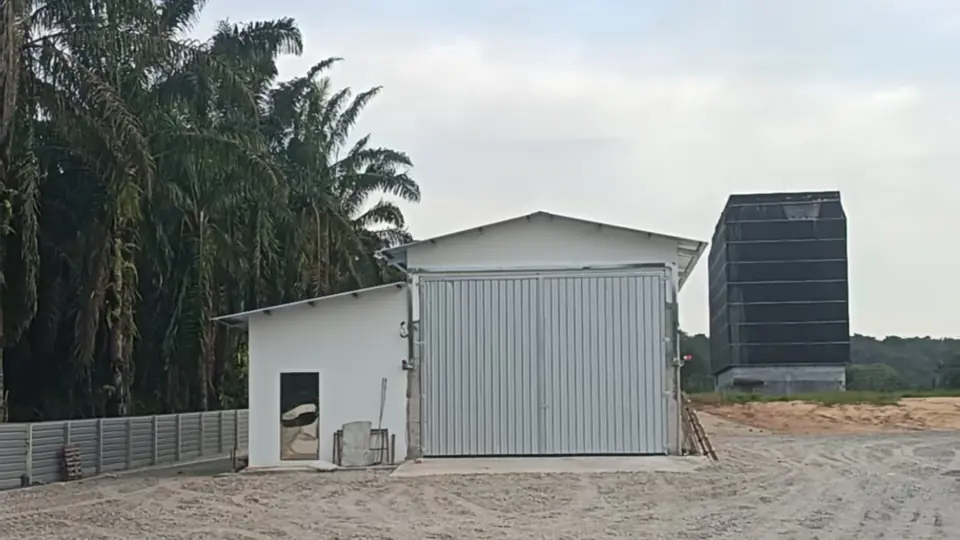
Our P05 drying bay overcomes monsoon saturation through automated vapor exhaust dampers synchronized with high-output insulated supply plenums. Wet steam clears out continuously during peak evaporation, letting heat transfer drive steel surfaces past 70°C in repeatable 30 to 45 minute cycles. One Commercial Swine Production Group in Perak, Malaysia verified this cycle stability in year-round monsoon heat and reordered four consecutive P05 chambers.
- One-touch PLC touchscreen executes pre-heat, 70°C+ timer lock, vapor purge, and cooldown automatically.
- Digital cycle audit logs prevent rushed drivers from terminating thermal holds prematurely during busy dispatch waves.
- Matched 40 kW electrical fan load runs on standard AC 380V / 50Hz with 60Hz export motor customization available.
5. Connecting 20 MPa Wash Bays, TADD Chambers & Gate PCR Swab Audits
Never use heat to compensate for incomplete washing. Dried pig feces insulates pathogens inside porous crusts and scorches onto stainless and aluminum decks, making subsequent trips even harder to clean. Keep strict one-way dirty-to-clean progression: IP67 chassis undercarriage jets (P03), 12 m telescopic 360-degree interior scouring across up to 3 lanes (P01), touchless exterior arch disinfection (P02), straight forward into the P05 TADD chamber.
Once trailers cool down in the clean yard, biosecurity teams verify high-risk spots using environmental swabs on our UPN0102 or UPN0104 closed-cartridge PCR analyzer. Printing a negative PRRS and ASFV gate slip alongside the PLC drying log turns your off-site hub from good intention into auditable protection.
- Avoid bare generic trailer searches: specify pig and swine livestock haulers (<14 m length) during yard CAD design.
- Start modularly with 1 automated wash lane + 1 drying bay for 8–12 rigs/day, or scale to 40+ trucks across 3 lanes and 4 dryers.
- Include a 5-day civil CAD pack specifying sloped sediment-trap trenches and concrete drive-through aprons.
Engineer Your 700–800 kW Swine TADD Truck Drying Hub
Send your daily livestock trailer count, trailer length (<14 m), and local humidity range for a 5-day dirty-to-clean CAD layout and FOB/CIF quote.
Inspect P05 Drying Room Specs